



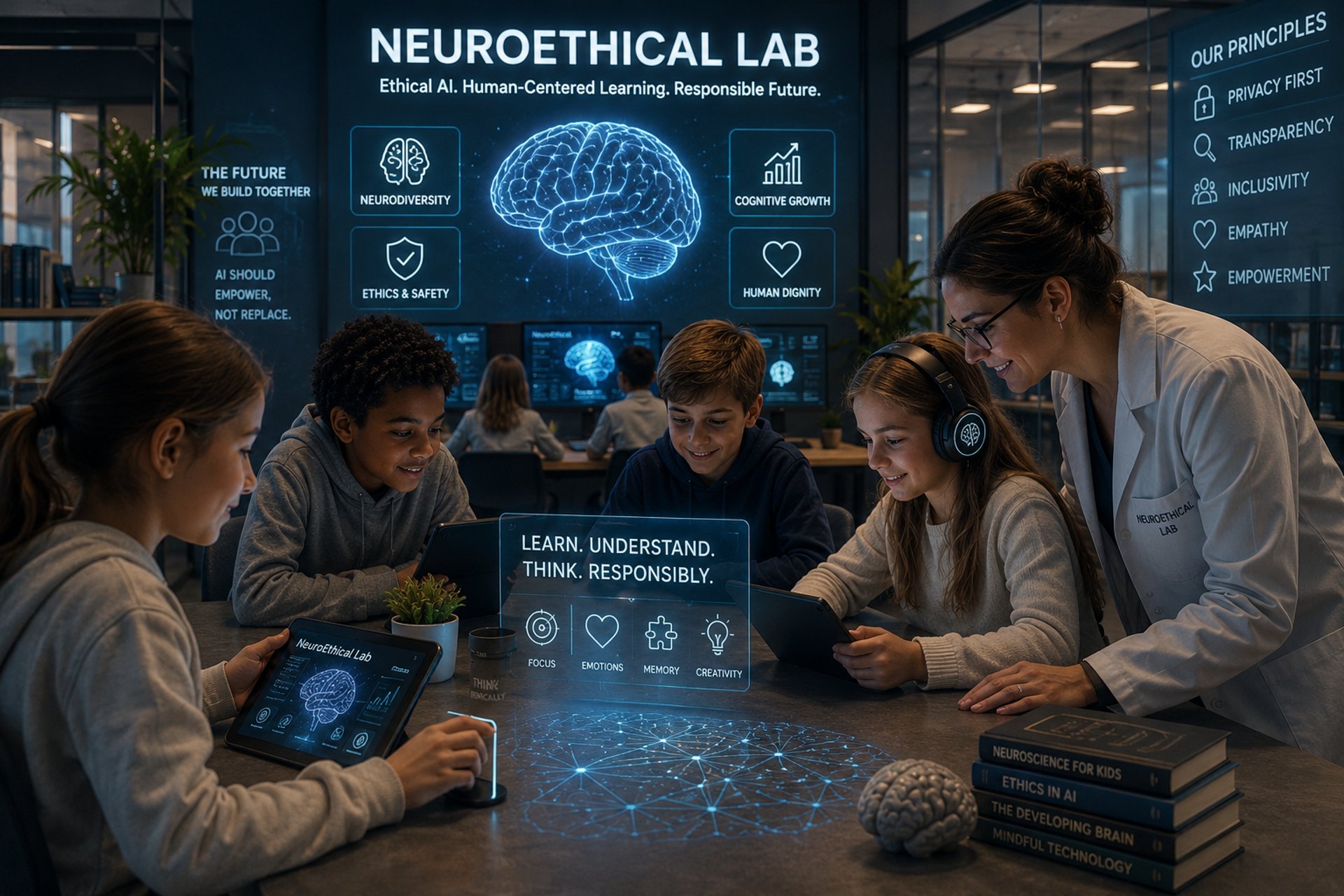
NEUROETHICAL LAB — RESEARCH METHODOLOGY
The Official Scientific & Cognitive Impact Assessment of the Integrum AI Compliance Chamber (2025–2026)
Status: Independent methodological research group and neuroethical examination facility.
1. MISSION OF THE LABORATORY
The NeuroEthical Lab is the scientific and neuroethical core of the Integrum ecosystem, where clinical psychologists, special education experts, and AI systems engineers collaborate to investigate the cognitive and neurological impacts of generative artificial intelligence.
The greatest dangers of modern digital education and cloud-based AI applications are cognitive overload, dopamine fragmentation, and attention splintering. The laboratory’s primary mission is the scientific validation of evidence-based methodologies and localized technological environments (Integrum Fortress™) that support, rather than burden, the development of the human nervous system.
2. CLINICAL & PEDAGOGICAL IMPACT METRICS
During the pilot programs monitored by the Chamber (encompassing 12 schools and 1,400 students), we place a dedicated focus on the neurodivergent learning processes of children with Special Educational Needs (SEN), ADHD, and Autism Spectrum Disorders.
Validated Metrics (Within Closed, Localized AI Environments):
+21.0% Increase in Sustained Attention: Within the streamlined environment of Integrum Fortress™—fully isolated from visual noise and advertisements—the focus duration of students diagnosed with SEN/ADHD expanded significantly (verified via standardized Conners CPT assessments).
Reading Comprehension Gains: A scientifically verified +18.2% increase within the neurotypical cohort and a +5.4% improvement within the ADHD student cohort (p<0.01).
Significant Reduction in Anxiety Levels: Utilizing predictable, closed-structure assistant systems providing immediate, non-judgmental feedback resulted in a demonstrable drop in learning and performance anxiety.
+55% Mentor Time Efficiency: By intelligently reducing the administrative burdens on facilitators (educators), significantly more quality time is reclaimed for direct, human-focused mentoring.
3. THE SYNAPSEAI™ STANDARD AUDIT METHODOLOGY
The SynapseAI™ Standard, developed by the NeuroEthical Lab, is a rigorous, objective matrix used to audit educational and corporate AI implementations. The verification process dissects three primary dimensions:
1. Cognitive Sovereignty: Does the software architecture structurally prevent dopamine overloading (digital addiction) and actively promote cognitive growth?
2. Zero-Egress Data Isolation: Is it architecturally guaranteed at the hardware level that a child’s individual developmental, psychological, and behavioral profile never exits to global cloud-based corporate databases?
3. Human-in-the-Loop: Does the technology genuinely reinforce and augment the educator-student relationship, or does it attempt to replace it? (In total alignment with Article 14 of the EU AI Act).
SCIENTIFIC COOPERATION & CONTACT
The NeuroEthical Lab welcomes collaboration with domestic and international universities, research institutes, and special education centers. To join as a research partner or to request an institutional cognitive impact assessment, please contact us: